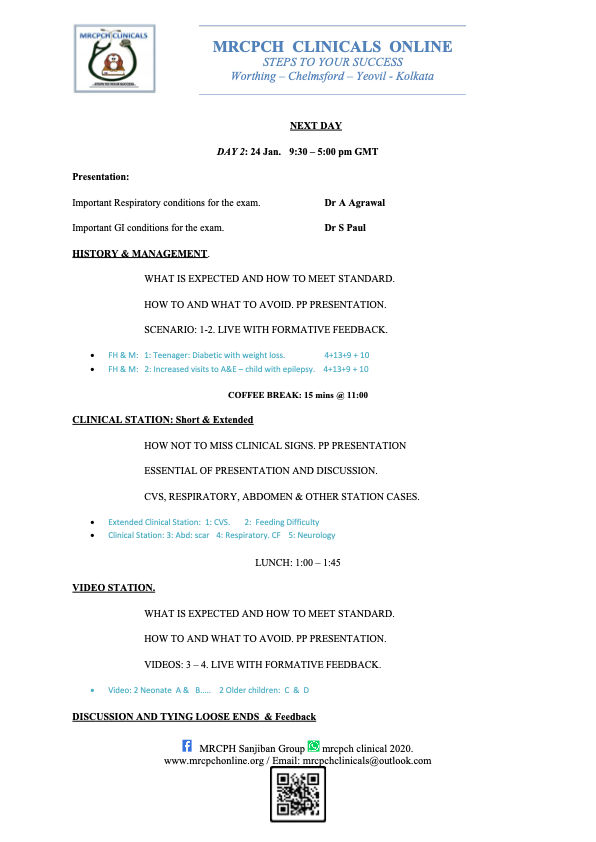
Spring Session: Covid Adapted MRCPCH Clinical Exam

We will start the Spring Session on 2 March 2021.

Covid adapted MRCPCH Clinical with review of current exam held in UK and some feedback.

Anil Garg is inviting you to a scheduled Zoom meeting.

Topic: COVID Adapted MRCPCH CLINICAL EXAM
Time: Mar 2, 2021 03:00 PM London

Join Zoom Meeting
https://us02web.zoom.us/j/2191937091?pwd=MWNrMFkrYmVuTTAyZ0RvMTF6UzN3UT09

Meeting ID: 219 193 7091
Passcode: mrcpch

Review Session and Road map to next diet …..

Dear All

Tomorrow we will have a review session. First session will be open to all.

We will discuss the current diet of Covid adapted Clinical exam, some feedback.
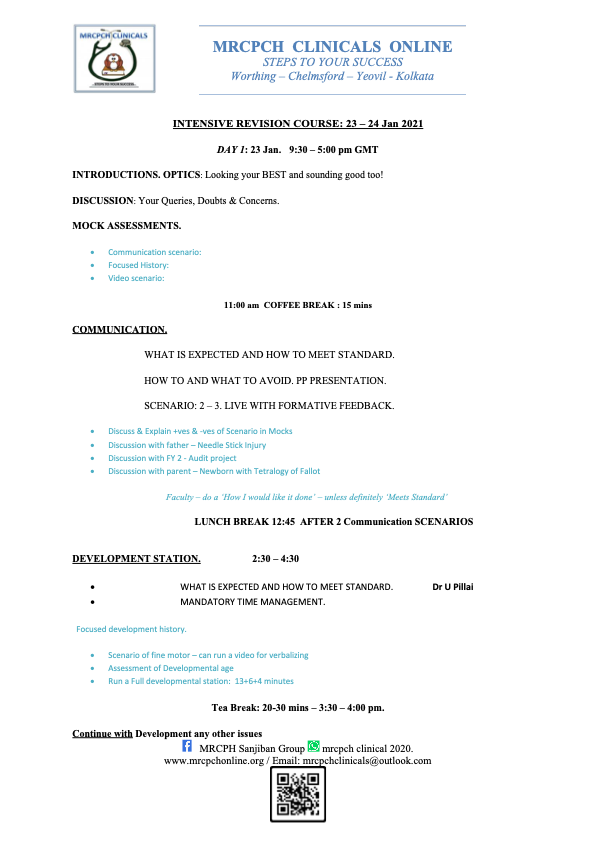
We will have presentation of Clinical exam, how to prepare and what we offer to help you prepare for the exam.
Interactive Zoom Sessions, Online modules and Intensive Revision Course.
Anil Garg
Anil Garg is inviting you to a scheduled Zoom meeting.
Topic: Anil Garg’s Zoom MeetingTime: Feb 23, 2021 03:00 PM London
Join Zoom Meetinghttps://us02web.zoom.us/j/2191937091?pwd=YktsU3B5TXlld2VpWjhLemEvV3A0Zz09
Meeting ID: 219 193 7091

Extended Clinical Station: CMPA….

Thank you for participating in the session – Universal cues were of a 4 month old failing to thrive with eczematous rash on face, greenish stools.

History was well taken by Dr S covering most of the essential points. Differential diagnosis and discussion went well.
The learning points were:

  • Structured history is essential.
  • Note relevant points to check in 4 minutes while reviewing the universal cues.
  • Keep a timer in view to keep to your time line.
  • 7 minutes on one point with not time to cover other essentials is BAD use of your time.
  • Learn to be confident of your ‘findings’ and summarize succinctly in under 30 secs.

I would like to wish ‘Best of Luck’ and a successful exam for our trainees who are writing the exam in this Diet.


We will complete the Winter session on 23 February and start the Spring session on 2 March.

Visit www.mrcpchonline.org to add your comments or suggestions.


Anil Garg

Clinical Station … MPS..

Thank you for participating in the session and making it interactive and interesting.

The video clip was of a boy with Hurler’s syndrome, on treatment. All clinical cues, universal and dependant were suitably picked up though could have been a little more organised Dr M in the later session covered the whole station with a Grade A+.
The learning points were:

  1. Do not omit obvious signs – note and mention them
  2. Check the introduction carefully – clue to what is expected in exam and management
  3. Derive a DD while watching the cues with relevant questions
  4. MPS – features appear usually after 6/12. Some may improve with treatment.
  5. Summary should be brief – if you have a diagnosis: say if and then support it
  6. Do not just narrate your findings – you are eating into your time.

Add your comments or anything I may have missed.
Anil Garg

Clinical Station – Other – ‘Neck swelling’..

Thank you for participating in the session and making it so interesting and interactive.

The scenario was younger of 12 referred by GP for being tired and deteriorating academically. A neck swelling was noted. The task was to examine the neck and any other relevant examination.
DR V took the hot seat and had a good attempt at the examination and discussion. Other gave their contributions after and in the end all was noted and discussed.
Learning points:

  • Any Clinical station: Summarize Universal cues in 30 seconds and proceed from there …
  • DD of midline neck swelling: Thyroid, Thyroglossal cyst, Cystic hygroma
  • Neck swelling – palpate from the back beside the front – need to vocalize clearly.
  • Try to get ‘under’ the swelling. If cannot percuss sternum from extension of swelling.
  • Auscultate over the swelling for bruits.
  • Check eye signs, leg swelling – oedema due to hypothyroid.
  • ‘Pubertal Goitre’ is common in girls and is Euthyroid.

Add your comments of points I may have missed.


Anil Garg

Video & Neurology Scenarios ….

We discussed a scenario of 6 month old presenting with vomiting. there was evidence of a repaired meningomyelocele and insertion of VP shunt. We covered how to develop differential diagnosis in this case. And …
14 year old with universal cues of hemiplegic gait, shortening on left limbs but generally very well.

The learning points:

  • approach to a child with vomiting and ‘VP shunt’.
  • VP shunt examination for obstruction
  • CT Shunt series of head for quick assessment for ‘broken’ shunt
  • MRI is not appropriate as it takes long and will require sedation
  • Good brief description / summary of universal cues
  • Focused history questions
  • Specific examination: Neurological exam: Muscle bulk / Power / Tone / Reflexes – Augumentation
  • MSK examination: range of movements is more appropriate
  • Exam is a ‘Performance’ Write your own script for each station & PRACTICE, PRACTICE, PRACTICE

Add your comments or anything I may have missed.
Anil Garg

Neurology Station …..

Thank you for participating in the sessions on Tuesday and Thursday following a very successful Intensive Revision Course.

We covered the neurology station initially working through a template of how the station could be attempted and then yesterday working through a case which on universal cues was likely to have Duchenne muscular dystrophy. Dr J took the hot seat. He covered a lot of points and was followed by Dr M who covered further.
Learning points:

  • Be structures in your approach
  • Describe your summary of Universal cues in 30 seconds – mention now will proceed with rest of the task..
  • General physical examination is part at any clinical examination station.
  • Spend 30 seconds – standing 2 feet away from the patient observing the surroundings & ‘child’.
  • Wheel chairs / splints / walking aids / features of child
  • Test Gait – describe
  • Test power in muscle groups at each joint – ONE at a time
  • Do not ask details of three joints in one breath
  • Do not forget 4 / 5 Ss – Squint / Shunt / Spine / Shoes / Scars – (tenotomy)
  • Diagnosis DMD: Family history – CPK – Dystophin gene. Biopsy not done.

Add your comments or any points I may have missed.
Anil Garg
History Station … Constipation Encopresis ..

Thank you for participating in the session today and sitting through our trial of ‘new’ technology for us – breakout rooms in zoom. IT did not go as I expected but it did give an opportunity to more hotseat experience and discussion beneficial to all.
Learning points:

  • Good introduction / opening statement: ‘We are meeting because your daughter has a problem tell me more ….’
  • ‘Why are we here today?’ … sounds grating to ears – even though correct.
  • I would say what I information I have and then build on it.
  • “I have letter from your GP mentioning Deborah, your daughter, has a problem with her phoo. Can you tell me more…’ Then keep quiet. OR words to this effect.
  • Read up common conditions.
  • Differential diagnosis and key question points in the 4 minutes while ‘reading & waiting’.
  • Ask relevant questions.
  • Remember examiner has been listening so DO NOT make up later. Admit you forgot to ask.
  • Management plans need to be suitable to scenario.
  • Be aware of treatments used and also a reasonably well informed of drug actions.

    add your comment or any point I may have missed.

Anil Garg

History Station … Headache…

Dear All
Participating in the session today. We covered a history station.

A 16-year-old had presented with worsening headaches for the past 2 to 3 months. Dr P did an excellent role play and was too good to offer a lot of information not requested. Dr A was in the hot seat. Most of the points in the history were covered but some important points were missed. As a whole group all was mentioned and covered.
Mistake was made of moving from H&M to Communication mode. Presented Power Point on History & Management.

Learning points:

  • Work our differential while viewing the information and differentiating questions in 4 minutes.
  • HEADSS
  • Social & family life
  • Detailed current medication / drug history / compliance
  • DO not move to Communication mode.
  • Brief summary with + & – ve points to support your first diagnosis
  • Important DD offer for discussion
  • Management is a Team – effort – you do not need to manage all options
  • Discuss with Consultant
  • Hemiplegic Migraine is a diagnosis of exclusion by Paediatric neurologist
  • Imaging with Chronic is an almost must. Can delay it till discussion with consultant.
  • Do not go to Psychiatry before ruling out space occupying lesion – it may be the cause!
  • Not neurological exam – does not rule out a Space Occupying Lesion
  • Head smart card – check put.

Visit www.mrcpchonline.org to Add your comments or any point I have missed.
Anil Garg